

We created an AI healthcare community for AI and healthcare professionals. Here’s what I learned.

Background
My vision is to advance Taiwan’s healthcare industry with AI to save more lives. I started a study group with AI experts and healthcare professionals, including doctors. I believe this is the most direct way to positively impact human well-being, and we have the right people and timing.
The study group meets online every two weeks. An AI expert or healthcare expert hosts each session. AI experts share the latest technology; healthcare experts present clinical problems with context. This setup brings these two groups, who usually don’t interact, closer together and builds trust.
Sample sessions include:
“Why do they choose to LOG OUT of the world?” — a mental health expert.
“Surgical Image Recognition” — a surgeon.
“From Raw Data to Real Insight” — a software engineer.
“Vibe Coding” — a software engineer.
Lesson 1 — Unexpected Knowledge Discovered
Sharing from diverse experts consistently provides new, valuable knowledge we might never discover otherwise. For example:
AI Scribe: Learning about AI Scribe and AI models for doctor appointments, we saw real-world clinical applications at our members’ hospitals. Our members were excited to see our ideas align with these cutting-edge clinical tools.
Health Benchmark: A member shared HealthBench immediately after its release by OpenAI. We explored its details. Weeks later, we learned the benchmark promoted the new GPT5 model’s healthcare capabilities. Members were excited to be so close to the industry’s latest technologies.
Lesson 2 — Significant Personal Learning
Beyond new knowledge, I gained many high-level insights from the sessions:
First, for AI applications, data quality is paramount. Our focus will be on evaluating and generating high-quality data, rather than simply acquiring more.
Second, the AI healthcare domain is vast but can be categorized into image-based, text-based, and mental health applications. Image-based applications present the most problems, from estimating burn severity to classifying cancer images. Text-based applications are mature and integrated with current medical record systems. Mental health applications have a strong need for better solutions, as current market offerings often fall short.
Lastly, AI excels at some problems but struggles with others. For instance, AI in LLM models like ChatGPT or Gemini answers healthcare questions much better than human doctors. I tested one on a therapist certificate exam, and it scored almost perfectly. However, we agree AI is far from solving realistic problems like providing long-term therapy for patients with severe mental illness.
Lesson 3 — People Want More
After over six months of hosting the study group, I collected feedback to ensure continued growth. The most common feedback was “people want more.” Members enjoy discussions that broaden their horizons and reveal opportunities, but they want to seize these opportunities and create actual impact.
Considering this feedback, I designed a diagram to illustrate the problem and my solution.
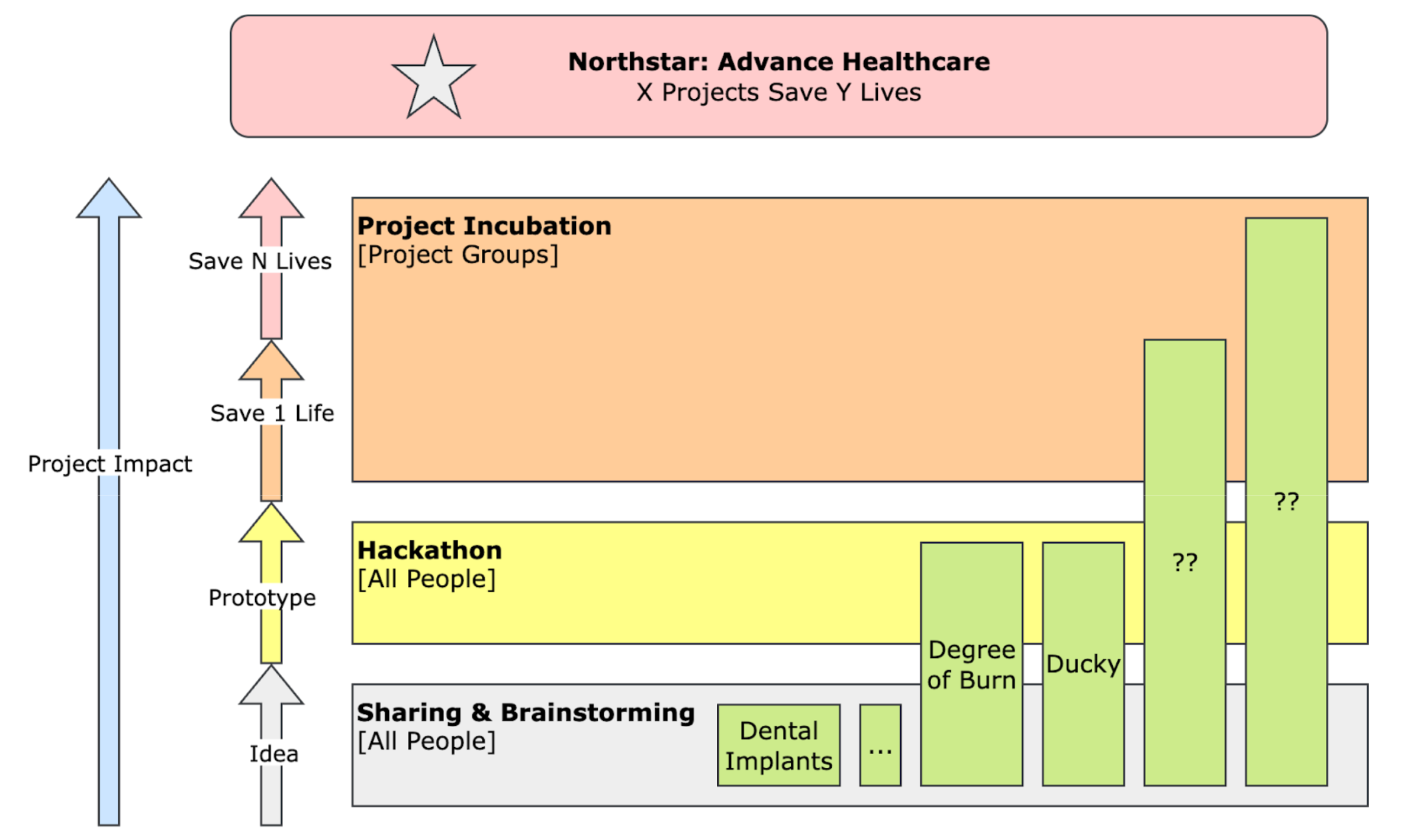
The diagram plots topics (X-axis) against impact (Y-axis). For each topic, we discuss, prototype, and then form a project group for execution. Our study group initiates topic sharing and discussion (gray box). We also started “mini hackathons” to prototype promising topics (yellow box).
Moving forward, I’m transforming the group to “incubate” projects (orange box). We will implement a process for members to pitch projects, find partners, and receive feedback from other members. This setup will bring our amazing group closer to achieving the impact we envision.
Summary
I’m honored by the participation of such distinguished AI healthcare experts in our study group. Together, we’ve fostered a strong community and are well-positioned to achieve our initial impact objectives. If this resonates with you, please visit https://www.ai-healthcare.group/ to learn more and request to join.